Diplomacy & Etiquette
International Behaviour. Protocol. Presence
International Behaviour. Protocol. Presence
Welcome to our Smart Autarky Courses
International Protocol & Diplomacy form the foundation of professional conduct in international, diplomatic, and cross-cultural contexts. This programme explores etiquette, presence, and first-hand practices that go beyond written rules and formal manuals.
Not ignored. Not unheard. But quietly dismissed, while the room convinces itself that everything is understood.
For human rights defenders, this happens regularly. But it is not limited to that field. It happens wherever complexity exceeds comfort.
Winston Churchill
In a recent high-level legal context, cooperation between Hannah and diplomatic counterparts was dismissed as “conspiracy theory” — not because it lacked substance, but because engaging with international law was considered too complex, too time-consuming, and, quite frankly, inconvenient. The matter was not debated. It was avoided.
When clarity is labelled disruption, and expertise is reframed as speculation, diplomacy becomes necessary.
When Hannah read the judgment… she laught loud. In 20 years she never heard such lack of reality, absurdity.
Hannah picked up the phone, and called the state directly to announce a so called unlafwul kingdom.
Not to accuse. Not to escalate. But to restore orientation and to reach the hand.
She called it the latest diplomatic joke. She pointed out, calmly, that when international cooperation is dismissed without examination, it is not the individual who is undermined — it is the sovereignty and credibility of the state itself. As the protection shield and an elite Human Rights Defender it is her ethics and diplomacy to reach out to those understand and are able to decide for humanity.
Reason, in that moment, had to speak somewhere.
This we call the lighthouse diplomacy: Having the right phone number when illusion of understanding and price of ignorance raising up.
What happened to the judge ? The end of the story she will tell you in the course.
He was on her wish list to restore reputation and dignity. Hannah is known for her humor and creativity.
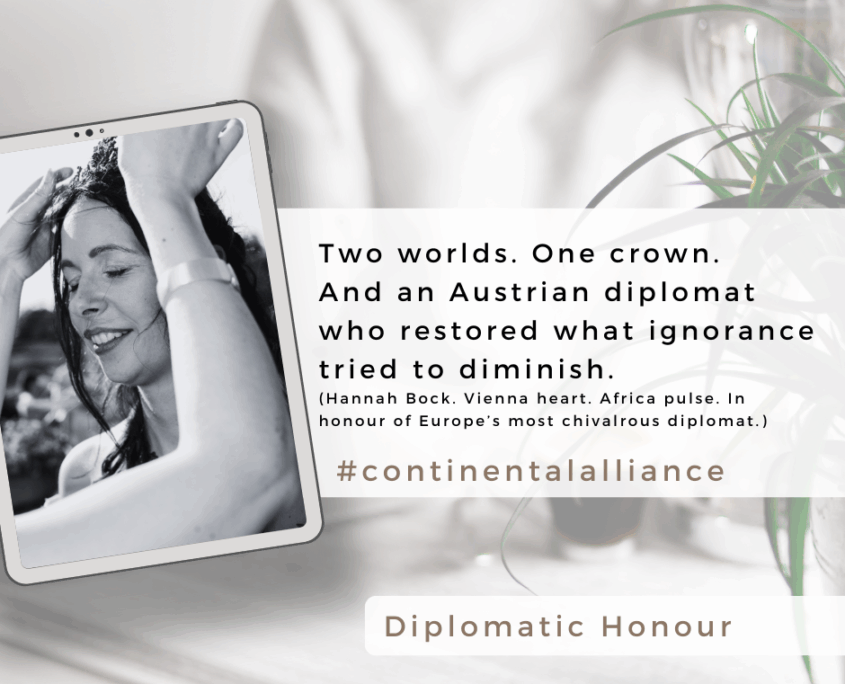
This programme is shaped by Hannah Bock, Speeaker to UN Human Rights Council, former Deputy Head of Delegation for Civil Society, a role held at equivalent diplomatic rank to a second ambassador of a state.
She has roots in European nobility and roots within the old Kingdom of Ségou. She was trained in court traditions across major regions, including French diplomacy and the historic Schönbrunn German court tradition as well as cultures across the globe.
She knows:
Because real etiquette is not obedience.
It is judgment.
In our Smart Autarky Courses we focus on diplomacy as a subtle method for managing conflict, negotiating, or dismissing opposing views without causing immediate rupture. Later in the Mastermind courses or private lessons, we show you as well how to survive a state dinner, how to know if it is a good wine and how you impress anyone as you would be a sommelier.
At the United Nations, Hannah was known for something unusual.
She would ask diplomats, ambassadors for a coffee or call a special rapporteur on the phone—
and turn a crisis in the Sahel into a lighthouse moment or rescue with a call someones life.
Not in plenary. Not on record. Only the little corner in at the café at Palais des Nations in Geneva.
But in the quiet spaces where real diplomacy happens.
Sometimes, she was handed a microphone by a state, because civil society was not officially allowed to speak.
Protocol allowed it — because wisdom demanded it.
There is an unspoken rule in diplomacy:
When an elite defender has an idea but no voice, a diplomat is kind and wise enough to recognise it.
That is what happens behind secret doors.
When Hannah first entered the House of Lords, she did not introduce herself.
She did not explain her background.
A senior Lord observed her quietly, understood her origins and then said:
“When protocol no longer reaches far enough, the ancestor wool and a Lord must fulfil their duty to heritage. One must know and understand who stands before them — even when it cannot be seen and named.”
“Highness.”
No title had been claimed. No rule had been cited. Yet the room adjusted.
That is presence.
International Protocol & Diplomacy form the foundation of professional conduct in international, diplomatic, and cross-cultural contexts. This programme explores etiquette, presence, and first-hand practices that go beyond written rules and formal manuals.
Everyone can learn protocol. Very few understand when protocol stops working.
This programme is about what happens behind closed doors:
when hierarchy is unclear, when power shifts, when no one officially has the microphone — and yet decisions are made.
If you have ever sensed that diplomacy is less about rules and more about recognition, you are right.
At the United Nations, Hannah was known for something unusual.
She would ask diplomats, ambassadors for a coffee or call a special rapporteur on the phone—
and turn a crisis in the Sahel into a lighthouse moment or rescue with a call someones life.
Not in plenary. Not on record. Only the little corner in at the café at Palais des Nations in Geneva.
But in the quiet spaces where real diplomacy happens.
Sometimes, she was handed a microphone by a state, because civil society was not officially allowed to speak.
Protocol allowed it — because wisdom demanded it.
There is an unspoken rule in diplomacy:
When an elite defender has an idea but no voice, a diplomat is kind and wise enough to recognise it.
That is what happens behind secret doors.
This programme is shaped by Hannah Bock, former United Nations speaker and Deputy Head of Delegation for Civil Society, a role held at equivalent diplomatic rank to a second ambassador of a state.
She has roots in European nobility and roots within the Kingdom of Ségou (today Mali).
She was trained in court traditions across major regions, including French diplomacy and the historic Schönbrunn German court tradition.
She knows:
how to sit correctly at court
how to speak when silence is expected
how to break a rule without ever shaming anyone
Because real etiquette is not obedience.
It is judgment.
When Hannah first entered the House of Lords, she did not introduce herself.
She did not explain her background.
A senior Lord observed her quietly, understood her origins and then said:
“When protocol no longer reaches far enough, the ancestor wool and a Lord must fulfil their duty to heritage. One must know and understand who stands before them — even when it cannot be seen and named.”
“Highness.”
No title had been claimed. No rule had been cited. Yet the room adjusted.
That is presence.
She laughed.
Not out of defiance.
Not out of disrespect.
But because the situation had quietly crossed the line from legal reasoning into absurdity.
Then Hannah did something unexpected.
She took out her phone.
And said calmly:
“In that case, I should probably call the government and inform them that UN diplomacy has officially been reclassified as a conspiracy theory.”
A pause.
A smile.
Then she added, almost gently:
“Someone has to remain reasonable when the price of ignorance becomes visible.”
She did not call to provoke.
She called to protect.
Not her own position —
but the diplomatic integrity and sovereignty of a state.
Shortly thereafter, the misunderstanding was acknowledged.
An apology followed.
Not because power had been challenged —
but because responsibility had been exercised.
Later, she asked quietly:
“Blue tea?”
Those who understood smiled.
In diplomatic circles, blue tea is not a drink.
It is a symbol — of market shifts, of subtle power realignments, of moments when influence moves without noise.
No confrontation.
No spectacle.
Just recognition.
 Behind the Web of a Digital Spider | 7 books revealing the hidden mechanics...